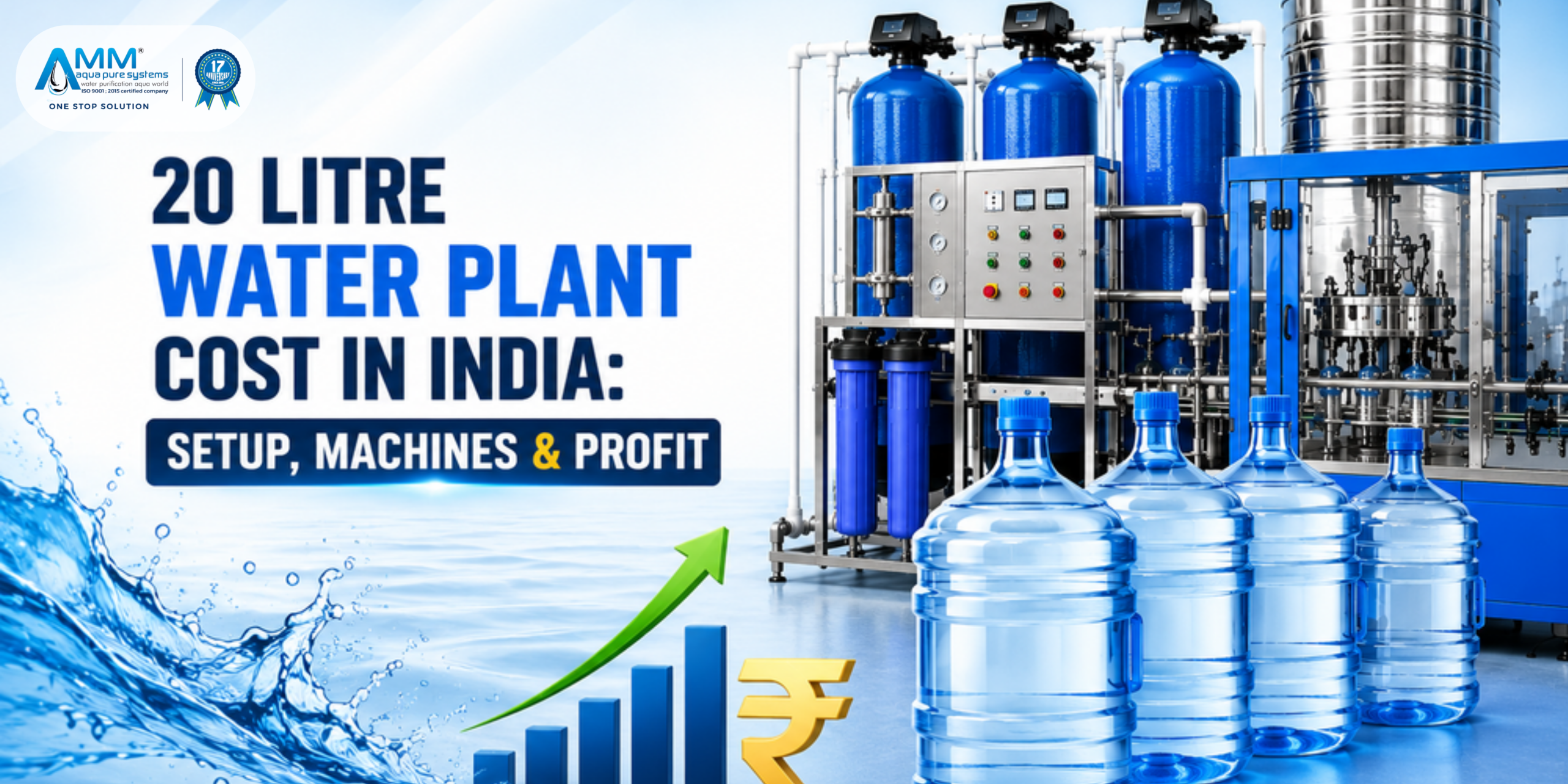
The demand for 20 litre packaged drinking water jars is strong among offices, apartments, hotels, restaurants, hospitals, factories and commercial establishments across India. For entrepreneurs, this creates an opportunity to build a recurring local water supply business.
But before investing, the key questions are:
How much does a 20 litre water plant cost in India? What machines are required? How many jars can you produce per day? Is the business profitable?
This guide covers the 20 litre water plant cost in India, machinery, production capacity, space, operating expenses and profit factors to help you plan your investment.
What Is a 20 Litre Water Plant?
A 20 litre water plant treats raw water and fills purified water into reusable 20 litre jars.
A typical setup may include:
- Raw water storage tank
- Multi-grade filter
- Activated carbon filter
- RO water treatment plant
- UV or ozone system
- Purified water storage tank
- 20 litre jar washing system
- Jar filling machine
- Capping system
The final configuration depends on raw water quality, required capacity, automation and business requirements.
20 Litre Water Plant Cost in India
The 20 litre water plant setup cost is not fixed. It varies according to plant capacity, automation, water quality, machinery configuration and site requirements.
| Setup Type | Approx. Capacity | Indicative Investment |
| Small / Semi-Automatic | 250–500 LPH | ₹5–10 Lakhs |
| Medium / Semi-Automatic | 500–1,000 LPH | ₹8–15 Lakhs |
| Commercial | 1,000–2,000 LPH | ₹15–35 Lakhs |
These are indicative project ranges, not fixed equipment prices. The final cost may change based on:
- Raw water test results
- RO capacity
- Jar washing and filling system
- Automation level
- Storage capacity
- Plant layout
- Installation and electrical requirements
For an accurate estimate, get a customized quotation based on your water source and required production capacity.
Factors That Affect 20 Litre Water Plant Cost
1. Production Capacity
The plant capacity should match your expected daily demand. Common capacities include 250 LPH, 500 LPH, 1,000 LPH and 2,000 LPH.
For example, a 1,000 LPH system theoretically produces water equivalent to 50 × 20 litre jars per hour. Actual output depends on operating hours, filling speed, jar washing and machine downtime.
Choosing capacity according to realistic demand can help control your initial investment.
2. Automation Level
Semi-automatic systems can be suitable for businesses starting with moderate production and available manpower.
Automated systems can offer:
- Faster production
- Consistent filling
- Reduced manual handling
- Better production efficiency
- Easier future expansion
The right level of automation depends on your budget and production target.
3. Raw Water Quality
Raw water quality directly affects the treatment system and project cost.
Before finalizing the plant, test relevant parameters such as:
- TDS
- pH
- Hardness
- Turbidity
- Microbiological parameters
- Other source-specific contaminants
The treatment configuration can then be designed according to the actual water quality.
4. Jar Washing and Filling System
Since 20 litre jars are reusable, proper washing and hygienic filling are essential.
Depending on production requirements, the plant may use:
- Jar washing machine
- Jar rinsing system
- Jar filling machine
- Capping system
Higher automation can improve consistency and reduce manual handling.
Machinery Required for a 20 Litre Water Plant
RO Water Treatment Plant
The RO system reduces dissolved impurities and produces purified water. Its capacity should be selected according to production requirements and raw water characteristics.
Multi-Grade & Activated Carbon Filters
These pretreatment systems help reduce suspended particles, chlorine, colour, odour and certain organic compounds before downstream treatment.
UV or Ozone System
UV or ozone can be incorporated for microbial control depending on the plant design and applicable requirements.
20 Litre Jar Washing Machine
A jar washing system cleans reusable jars before filling. Automated washing can improve cleaning consistency for higher production volumes.
20 Litre Jar Filling Machine
The filling machine fills purified water into cleaned jars at a controlled rate. The suitable model depends on required output and automation.
Capping System
After filling, the jars are capped to maintain hygienic packaging and prepare them for delivery.
How Many 20 Litre Jars Can You Produce Per Day?
Daily production depends on:
- RO capacity
- Filling speed
- Jar washing speed
- Operating hours
- Number of shifts
- Downtime
For example:
1,000 LPH ÷ 20 litres = 50 jars/hour
At 8 hours of operation:
50 × 8 = 400 jars/day
This is a theoretical calculation. Actual production may be lower because of washing, filling cycles, cleaning and maintenance.
Therefore, select your plant capacity based on expected sales and future growth, not only maximum machine output.
Space Required for a 20 Litre Water Plant
A small setup may require approximately 800–1,500 sq. ft., while larger plants need more space.
The facility may require separate areas for:
- Raw water storage
- Water treatment
- Purified water storage
- Jar washing and filling
- Empty and filled jar storage
- Quality control
- Loading and dispatch
A proper layout should provide hygienic movement of workers and jars while allowing easy equipment maintenance.
How to Start a 20 Litre Jar Water Business
Step 1: Identify Your Market
Potential customers include:
- Offices
- Apartments
- Hotels
- Restaurants
- Hospitals
- Schools
- Factories
- Shops
Recurring institutional customers can provide more predictable demand.
Step 2: Test the Raw Water
Water testing helps determine the appropriate filtration, RO and disinfection configuration.
Step 3: Estimate Daily Demand
Calculate the number of jars you realistically expect to sell each day. Consider your target area, competition, customer density and delivery distance.
Step 4: Select the Plant and Machinery
Choose the treatment capacity, jar washing system, filling machine and automation level based on your expected production.
Step 5: Prepare the Facility
Plan suitable flooring, drainage, electrical connections, water pipelines, production areas and storage space.
Step 6: Install and Commission
The selected manufacturer can install and commission the plant according to the approved configuration.
Step 7: Complete Applicable Compliance
Before commercial production, ensure compliance with applicable food safety, testing, packaging, labelling and local regulatory requirements.
Requirements can vary based on the business, location and water source. Verify the latest requirements before starting production.
20 Litre Water Plant Operating Cost
Initial machinery is only part of the total investment. Regular expenses can include:
- Electricity
- Labour
- Water
- Jar replacement
- Caps and consumables
- Cleaning materials
- Filter and membrane maintenance
- Equipment servicing
- Rent
- Transportation
- Marketing and distribution
For a 20 litre jar business, delivery costs can significantly affect profitability because jars are heavy and often require regular local delivery.
Is a 20 Litre Water Jar Business Profitable?
Profitability depends on your selling price, daily jar sales and operating expenses.
Consider:
- Daily production and sales
- Selling price per jar
- Production cost
- Labour
- Electricity
- Transportation
- Rent
- Maintenance
- Marketing
A simple calculation is:
Monthly Revenue = Daily Jar Sales × Selling Price × Working Days
Subtract your monthly operating expenses to estimate potential operating profit.
Building a customer base of offices, apartments, hotels and institutions can help create recurring demand.
How to Reduce Your Initial Investment
You can control setup costs by:
- Choosing capacity based on actual demand
- Selecting semi-automatic equipment where suitable
- Testing water before finalizing machinery
- Comparing complete project quotations
- Planning the layout before installation
- Choosing reliable equipment with service support
- Designing for future expansion
The cheapest machine is not always the most economical option. Reliability, maintenance and after-sales support should also be considered.
20 Litre Jar Plant vs PET Bottled Water Plant
| Factor | 20 Litre Jar Plant | PET Bottled Water Plant |
| Main Customers | Offices, homes & institutions | Retail & consumers |
| Packaging | Reusable jars | PET bottles |
| Repeat Demand | High potential | Depends on retail sales |
| Distribution | Mainly local | Local to wider markets |
| Starting Scale | Can start smaller | Often requires higher volume |
A 20 litre jar model can be suitable when your business focuses on recurring local customers and bulk water supply.
Why Choose AMM Aqua?
Choosing the right manufacturer is important because the treatment system should match your raw water quality and production requirements.
AMM Aqua provides water treatment and packaged drinking water solutions for businesses across India.
Solutions can include:
- RO water treatment plants
- 20 litre jar washing systems
- Jar filling machines
- Water bottling systems
- Customized plant solutions
- Installation and commissioning
- Technical support
- After-sales service
AMM Aqua can configure the plant based on your water quality, production capacity, available space and business requirements.
Get Your 20 Litre Water Plant Cost Estimate
Planning to start a 20 litre jar water business in India?
Don’t select a plant based only on the lowest advertised price. Your setup should match your raw water quality, daily production requirement, available space and target market.
Tell AMM Aqua your required capacity, location and water source to get a suitable plant configuration and project quotation.
Get a Free Plant Consultation & Quote
Discuss your requirement with AMM Aqua and find the right 20 litre water treatment, jar washing and filling solution for your business.
Frequently Asked Questions
What is the cost of a 20 litre water plant in India?
The cost depends on capacity, automation, water quality, treatment equipment, jar washing and filling systems, infrastructure and installation. A customized quotation is recommended.
What is the price of a 20 litre jar filling machine in India?
The price varies according to filling capacity, automation, machine configuration and specifications. The right model should be selected based on your required production volume.
What machines are required for a 20 litre jar water plant?
A typical setup may include an RO plant, pretreatment filters, disinfection system, storage tanks, jar washing machine, jar filling machine and capping system.
How many 20 litre jars can a plant produce per day?
Production depends on plant capacity, filling speed, washing system and operating hours. A 1,000 LPH system has a theoretical water output equivalent to 50 × 20 litre jars per hour.
Is a 20 litre jar water business profitable?
Profitability depends on selling price, daily sales, production costs, labour, transportation and other operating expenses. Recurring customers can help create consistent demand.
How much space is required for a 20 litre water plant?
A small setup may require approximately 800–1,500 sq. ft., while larger plants require additional space for treatment, jar handling, storage and dispatch.
Can AMM Aqua customize a 20 litre water plant?
Yes. The water treatment and jar washing/filling configuration can be planned according to raw water quality, production capacity, available space and business requirements.
Conclusion
A 20 litre water plant in India can be a practical business model for entrepreneurs targeting recurring demand from offices, apartments, hotels, institutions and commercial establishments.
The investment depends on capacity, raw water quality, automation, treatment equipment, jar washing and filling systems and infrastructure.
Instead of choosing a plant based only on price, select a system that matches your current demand and allows future expansion.
If you are planning a 20 litre water plant setup in India, AMM Aqua can help you select the appropriate water treatment and jar filling solution.
Get in touch with AMM Aqua for a customized quotation and project consultation.